Why batteries
Solar PV generates the most between 10:00 and 14:00. A typical household consumes power in the morning and evening. Without storage, you directly use only part of the generation and sell the remainder to the grid for a fraction of the price at which you purchase it in the evening. Batteries store the midday surplus and release it when the lights come on. On daily curve On the homepage you can move it yourself.
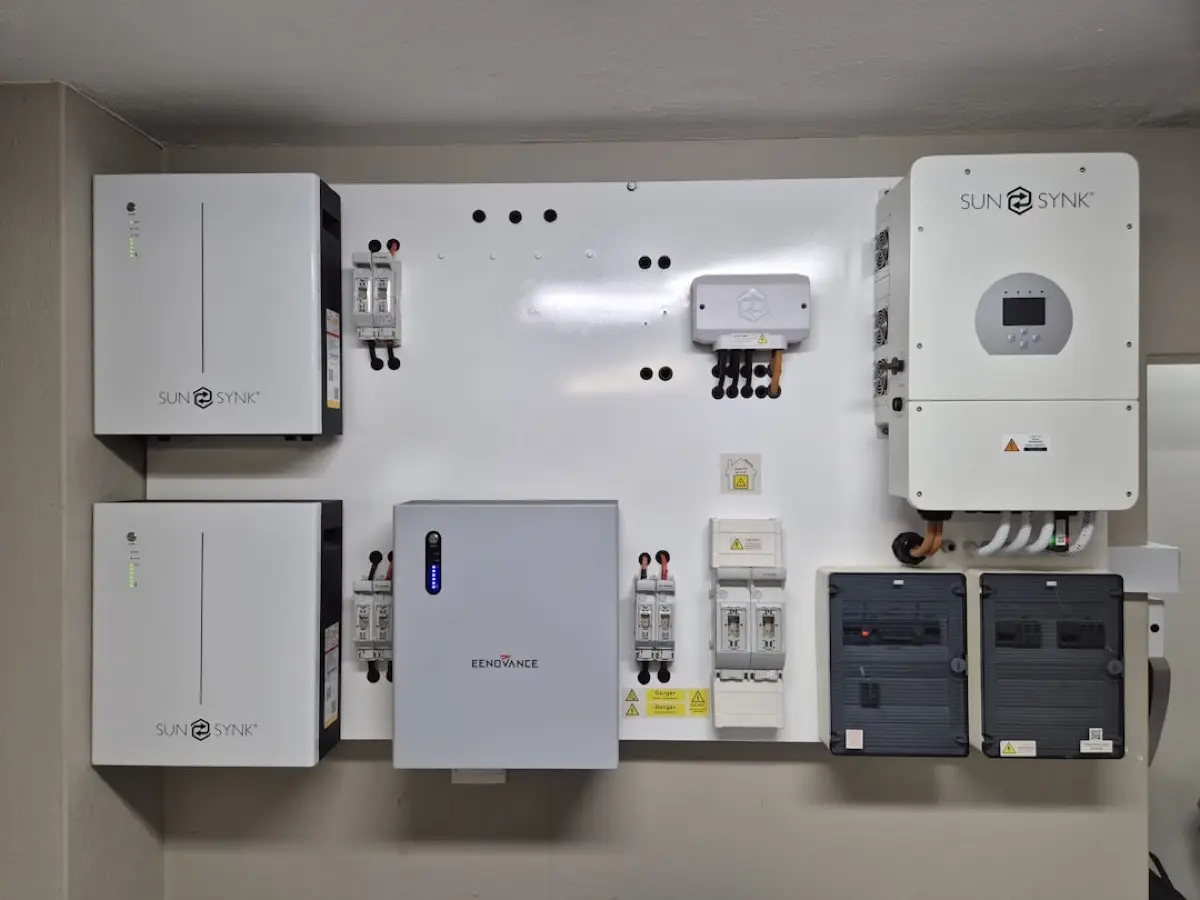
Which battery and what size
- LFP chemistry (lithium iron phosphate)safe, thermally stable, with long cycle life. Today's standard for residential and commercial storage.
- Modular composition. The capacity can be expanded over time with an additional module if a heat pump or electric vehicle is added. We take this into account when selecting the inverter.
- Capacityderived from consumption between sunset and sunrise and the plant's output. An oversized battery will not fully charge in winter, and you will not use its full capacity in summer.
- Discharge power. The battery must be able to start an induction hob, oven and pump simultaneously. The inverter and number of modules are decisive, not just the kWh.
Backup power during grid outage
A standard hybrid system disconnects during an outage because it must not feed into a de-energised grid. If you want the fridge, boiler, pump and lights to keep running, we will design a backup mode: an inverter with islanding capability, a switching device and separate backed-up circuits. This is a decision made at the start, not added later.
Virtual battery
A virtual battery is not a device but an electricity supplier tariff: excess feed-in to the grid is credited against later consumption, usually for a fee and only on the energy portion of the price. You continue to pay distribution charges and taxes. It makes sense for summer surpluses that a physical battery cannot store. Conditions vary between suppliers and change, so we compare them only in the proposal.
NZÚ 2026: For standard households, battery storage is a condition for an interest-free loan, and the subsidy is also calculated based on the battery capacity. Conditions in detail
Battery addition to an existing solar power plant
Do you have panels with a grid-tied inverter without a battery? There are two solutions: replace the inverter with a hybrid one, or add a separate battery inverter on the AC side. We will assess your existing installation, inspection status and remaining warranty, then recommend what makes sense. In the form, select "Adding a battery to an existing PV system".
Frequently asked questions about batteries
How large a battery do I need for my photovoltaic system?
Approximately as many kWh as you consume from sunset until morning, typically 5 to 15 kWh. Larger batteries have nothing left to charge them with, as the surplus from the roof is limited. We design the capacity based on your consumption pattern and the power plant's output, not from a catalogue.
Is a physical battery or a virtual battery better?
A virtual battery is a contractual service from an electricity supplier that offsets excess generation against consumption. It does not save distribution fees and will not protect you during a power outage. A physical battery uses surplus energy on-site, reducing both purchase costs and the distribution component, and has been a requirement for NZÚ support since 2026. They are often combined: a physical battery for daily cycles and a virtual one for summer surpluses.
How long do LFP batteries last?
Lithium iron phosphate cells typically handle 6,000 or more cycles, meaning over 15 years with one cycle per day before capacity drops to 70-80%. Manufacturers usually provide a 10-year warranty. We install the battery in a temperature-controlled space; cold and heat shorten its lifespan.